Posted on 4 Comments

Busy, Distracted, and Stinky

Sorry for the unexpected blog holiday.  I’ve been a bit scattered the last week and life has been busy.  No, Revision Xibalba is not going well.  I wrote a couple of hundred words, realized I had started the scene in the wrong place, and deleted them all.  I wrote several pages of notes at basketball practice, but I’ve been too busy to get them written into a scene, and I’ve been too tired to get up Dark & Early.  Argh!  It drives me nuts when I let life distract me!

Today will be no better, with basketball this morning and a possible road trip the rest of the day.

Now for the stinky…

Last night Uncle J and Aunt BB stopped by for dinner and then we helped them get a large gorgeous piece of artwork home on the other side of town.  We were on the freeway headed home behind a semitruck.  That Man noticed a dead animal in the middle of the road but we couldn’t swerve with cars on the left.  Besides, it was dead, right?  What harm could it cause?

Well, evidently it was a FRESHLY killed SKUNK, so fresh that it managed to spray the van. 

Now no one enjoys the smell of a skunk, except maybe another skunk, but That Man cannot stand “country” smells.  (You should see him driving by Iowa pig farms in the heat of summer with no air conditioning.)  He was gagging and retching, the kids were moaning like they were dying, and I sat there with my mouth shut tightly because if I opened it I could taste the skunk.  Ugh.  It really was strong, but it was funny listening to their reactions.

We started looking for a car wash.  I kid you not, we hit three and all three were closed.  *boggles*  It’s only our luck!

We had to circle all of town smelling like fresh roadkill skunk before we finally found a car wash next to the monsters’ old daycare.  We did the works, the $8 complete package, and then we parked the van outside overnight so it didn’t stink up the garage.  That Man cracked the windows, too, so hopefully the smell will air out.

I swear, I still smell that skunk, even after sleeping all night.  If the van still reeks, we will NOT be making the 3 hour roundtrip car ride to celebrate That Man’s parents’ wedding anniversary after basketball today!

Posted on 1 Comment

Inside My Mind

I know I’m probably the last person on the planet to see Gerald Butler’s Phantom of the Opera.

I had a prejudice against Phantom after seeing an older version when I was a kid.  I remember being soooo ticked at Christine for leaving the poor Phantom!  I just hated the whole “love triangle” thing, being forced to choose.  I have a certain expectation for love triangles that most people probably think is pretty whacked.  I mean, look at Rose.  *wg*  Anyway, I wasn’t that excited about seeing the Gerry version.  I mean, I like him well enough, but I wasn’t going to rush right out there to see it.

Then at Christmas, my nephew wanted the sheet music for Phantom.  I ended up hearing Music of the Night, and even added it to the playlist for Return to Shanhasson toward the end.  I loved the song, but it wasn’t DEEP in my head yet.

Thanks to Netflix, I finally decided to get Phantom and watch it.  Oh dear.  I’ve crossed the point of no return.  The Phantom of the Opera is there inside my mind.  I get chills just hearing the overture.  His power over me is growing stronger.  Literally, my mind feels consumed with the darkness, the image of the tormented man hiding and creating his music.  And oh, the end of the movie, where the long-lost ring appears on Christine’s tombstone…  *shivers* 

So between the Phantom and the Character Clinic, I’m behind on my goals.  I’ve watched the movie twice now and I’d really like to watch it one more time before I have to send it back.  Right now, I’m cursing the day I did not do all that the Phantom asked of me!  Anywhere I go from now on, the Phantom is going to be there, whispering, in the back of my mind.

Posted on 3 Comments

CC101 – The Game of Chance

This article has been difficult for me to write.  To be honest, I was reluctant, which told me more than anything that I should explore this idea.  In Holly Lisle’s Think Sideways class (see my right sidebar), she often recommends practicing and exploring the techniques that make you the MOST uncomfortable.  Don’t give up on them — they very well might be teaching you the most important thing you need right now.

So let’s explore the idea of “Chance” in creating a character.

I don’t have the source (if anyone knows, please comment with link or details), but years ago I remember reading an author’s recommendation that when plotting or developing a story, you should write down as many ideas as possible — and then throw them away and take the sixth (or some relatively larger number) idea.  Reason:  the ideas you come up with first are standard and most routine.  If you take the sixth or greater idea, then it’s more unique and less routine. 

In other words, don’t take the easy route — it’s too predictable.  And that’s exactly where the idea of “chance” can come into play.

There are many ways you can introduce an element of chance, inprobability, unexpected surprise, etc. into the plot and characterization of your story. 

  • If you have two options for a scene and you don’t know which way to go, you could simply flip a coin.  Heads, take the road to the left; tails, take the road to the right.
  • You could use Story Archetype cards.
  • You could use I Ching, “The Book of Change.”
  • You could use tarot (which I hope my friend, Jenna, talks about this weekend).

The coin idea is rather simplistic, so I’ll talk about the two major elements of chance I’ve used in the past.  In this post, I’ll concentrate on the Archetype Story Cards.  I’ll try to get up another post for I Ching later today.

Story Archetype Cards

These cards are similar to and were inspired by tarot, but are specifically geared toward Story.  Each of the 64 cards has several elements on it:  Moon, Element (e.g. fire, water, air, earth), Numerical value, and an image, whether a person or scene that might be inspiring.  The deck also comes with a handout that gives a brief description of each card and how you might use it.

For example,  “The Rune” card shows an ancient stone rising into a night sky with intricate carvings.  A single star sparkles to the right.  From the description, some key words are “symbols, metaphors, meaning, the nature of reality, the power of words to change reality.”  Isn’t that a bit spooky that I picked THIS particular card?  I just picked it up out of the deck, a bit conflicted about how to write this article, and I get a card meaning the power of words to change reality.  As storytellers, that’s our great desire.

Really, the whole process can get all goose-bumpy and hair-raising.  I’ve found some incredible inspiration from these cards and I really believe I wouldn’t have thought of those things without it.  The cards can help unlock parts of your brain that just haven’t found a voice yet.  I’ve never failed to get an interesting new idea when I’ve used the cards, and there are so many ways to use them!

For characters, the handy dandy handout that comes with the cards recommends that you shuffle and deal out two cards, one face up, one face down.

  • The face up card represents the face this character presents to the world.  e.g. the mask.
  • The face down card represents the hidden nature or secret motivation of this character.  e.g. tied to the motivating fear.

The trick is to open up your mind and simply let the images, colors, and symbols on the cards spark some new element you haven’t thought of yet.

Exercise:  I decided to do this method for the heroine in my current project, Morghan of Seven Crows, a “science fiction Regency spoof.”  This is real, with my thought process as I worked through the exercise.

  • Face up:  The Avatar
  • Face down: The Beast

My thought process:

  1. @#&*@% Why’d I draw the BEAST?  I have no idea what this means.  Why did I think this exercise in “live blog” would be a good idea?
  2. Clear mind and look only at images.
  3. Avatar:  Face up, the Avatar is my character’s mask, what she presents to the world.  Just looking at the card, I noted the following elements:  winged angel, young, beautiful; sword in one hand (which said justice or righteous vengance); armor (prepared for battle), nimbus of gold about her head (glory, holy, righteous). 
  4. Avatar:  number = 10 (final resolution); element = fire (power, energy, warmth, universal essence); Moon = waxing gibbous (rest, consequence, realization).
  5. Avatar:  from the handout:  “active hand of the divine, uncompromisable, justice, righteous retribution, bearing knowledge and sword.”
  6. Avatar, how can I use this?  Morghan definitely has a big goal coming into the story.  She wants to reclaim her father’s proper place in Society, not for herself, but truly for him.  She’s waging war, but not with swords, with the Game of Politics.  She’s skillful and right in many ways.  The big chill-raiser here are the WINGS.  That’s significant to the story and her character in particular.  (Hint: title involves crows.)
  7. Beast, face down, represents my heroine’s inner conflict.  My first impressions of the card’s image:  anger, rage, teeth bared, face in a snarl, red.  The associated element was water, which didn’t quite make sense to me.  Wouldn’t water douse the rage?
  8. Beast:  number = 1 (beginning, fundamental essence, energy without direction or form, basic, desire; Element =  water (emotion, passion, feelings, love, subtlety, creation).  Moon =  waning crescent (retirement, sleep, apathy, waiting).
  9. Beast: from the handout:  “inner conflict, denied desire, censorship, urges.  The battle against the Beast takes place in the heart and mind.  He represents inner challenges and urges.  A person afraid of own actions; ethical dilemma, betrayal, denial of truth.”
  10. Beast:  by now, all sorts of inner alarms are blaring.  Definitely, Morghan is denying a huge secret.  By denying that secret truth, and going to a place of rules and “censorship”, she’s going to feel even more caged.  She wants to fly — but can’t because of the fetters and blinders she put on herself.  She believes Society will clip her wings, but she was clipped and hooded long before she stepped on board the ship that would take her to her father’s home.
  11. The water element in the beast card begins to make more sense too, and gives me an idea for how to douse some of her rage.  Another chilling thing:  the hero is like a Chinese dragon, which was often associated with water.  Yeah, he’s going to be the key to helping her douse that inner rage.

See, isn’t that cool?  I never thought of the inner rage she must be feeling.  Inside, she’s boiling.  She’s mad, mostly at herself, and yes, at her father, and she’s dreading every single step that takes her to the goal, while outwardly she must play cool, calm, and completely in control.  She’s definitely an avatar fighting her inner beast.

Have you ever tried some element of chance to help you develop a character or overcome a block?

Posted on 9 Comments

CC101 – Lost in the Trees

God is in the Details.  Great.  But don’t get so lost in the trees that you can no longer see the forest!

Let me start with an example.  “Letters to an English Professor” (title will be changing) was a project I started back in 2007.  Actually, that’s not true.  A very preliminary idea was started in 2004, but I never finished it and it was really cheesy.  The only element that survived that draft was Conn’s name, and the fact that he was Dr. Connagher, an English professor at Drury University.  I finished the first draft around 49K (don’t laugh — I was trying for less than 30k!) and decided that I would add Conn’s POV in order to reach a single-title novel’s length.

Sitting there looking at roughly “half” a story and trying to decide where to put Conn’s sections, I came to a crucial realization.

  • I claimed that Conn was a professor, but he never did professor things on page.

In short, I had defined a bunch of details for my hero, but they were flat and useless.  Those character elements I’d thrown into the story because I thought they were “cool” were nothing more than a bunch of trees.  I’d lost sight of the forest entirely.

CLUE #1:  If you can remove a major trait or detail from a character and the plot isn’t affected, then you’ve got a problem.

Sitting there in horror, my jaw on the floor, I realized that I could have made Conn a firefighter who sometimes quoted poetry.  A doctor.  Anything.  And that’s bad when the title (at the time) involved “English Professor.”  Even the poetry quotations were “fluff” — or leaves to continue the forest metaphor — that did little to carry the story forward.

In short, I had a lot of revisions to do. 

Solution #1a: Make a list of ways to use the element to drive the story.

I created a list of eveything an “English Professor” might do. 

  • grade papers
  • prepare and give exams
  • office hours
  • student interaction:  cheating; missing class
  • other teacher interaction:  dealing with problem students; award ceremonies; substituting

Then I started brainstorming ways to use these elements as KEY scenes for Conn.  Some of these scenes were only for him, while others began affecting Rae’s scenes.  The more detail I added for Conn, the more I had to change in Rae’s story line.  (A great example of chaos theory:  A butterfly flaps its wings on page 1 and a tornado destroys Act III!) 

At first, this scared me.  I mean, I didn’t plan to change *that* much.  But the process was necessary.  If a scene became important for Conn’s arc, then naturally those scenes eventually had to affect hers.  In fact, I finally realized that I’d missed some fantastic opportunties in the first draft that now I could build on.

Solution #1b:  Consider making the character detail a static trait.

Conn’s habit of quoting poetry became his static trait.  He doesn’t just quote a fluff piece now and then — the poetry builds and supports the rest of the scenes.  I made the poetry more important by adding “pop quizzes,” an element that was barely there in the first draft.  He quizzes Rae on poetry several times throughout the story, and in one crucial scene, Rae realizes that he sometimes quotes poetry to calm himself and gain some control.  The plot became more tightly integrated, making the poetry quotations and pop quizzes more than a lark. 

If I cut those scenes out, the story falls apart.  That’s a good thing.  That’s exactly what I want.

Clue #2:  If you can remove the character entirely and the plot holds, you’ve got an even bigger problem.

In trying to flesh Conn out better, I gave him a best friend, Dr. Mason Wykes, mathematics professor extraordinaire.  I even had a theme song for Mason–More Than a Memory by Garth Brooks.  Mason had a nice backstory.  But very early on, I realized he didn’t do much for the story.  He was a supporting character, Conn’s best friend, yet he SUPPORTED nothing.  I couldn’t even call him a crutch.

Solution #2a:  “Every character is the star of his own story.” 

If you can’t give the character his own goal and motivation — and then put him in direct conflict with another character’s goal in the story — then you don’t need that character.  To fix Mason, I sat down and really plotted out his arc.  What did he want?  What did he need?  How did that affect Conn?  Could Mason be a source of conflict between Rae and Conn?  Absolutely.  In fact, I could probably do an even better job in this arena — I’ll watch for that opportunity as I go through editor revisions. 

Give the character a goal — or gut him.

Solution #2b:  Axe the character or combine with others into a new more 3-dimensional character.

I didn’t do this with Letters, but this solution did help me with the original version of The Rose of Shanhasson, which had literally a “cast of thousands.”  I thought that creating a multitude of characters with backgrounds and personalities was a good thing, when in reality, it merely cluttered the story.  Rhaekhar’s mother was in the first, and second, I believe, drafts, but she really had no goal.  She wasn’t a source of conflict.  When I axed her, I gave a lot of those “nurturing” elements to Alea.  As a result, she became a more rounded character.

Clue #3:  Bigger than life characters are interesting.

One of the flukes of Letters was Miss Belle, Conn’s grandmother.  I must give credit where credit is due, and admit that I got a ton of ideas for her from a list Evil Editor did a long time ago for “Miss Pettipants.”  I gave her several really funny or odd quirks.

  • she talks to ghosts, specifically her dead husband
  • she appears to be senile — but that’s what she wants you to think
  • she looooves pink  
  • she can’t cook
  • she’s nosy

And that’s just a few!  However, where I went wrong with Conn, I went right with her.  All of these little quirks are SHOWN on page and affect the plot in some small way. 

  • Rae believes Miss Belle to be a crazy old lady, but soon realizes that the old harridan is actually wickedly clever and could put the fear of God into General Sherman himself. 
  • Miss Belle is the driving force behind the story from the beginning–but Rae doesn’t discover this until much later. 
  • Miss Belle wears pink; she makes Rae sign the contract with a pink pen; she paints the columns on the front of the house pink; she gives Rae a pink parasol to beat her grandson over the head when he’s too bossy. 
  • She talks to Colonel Healy’s ghost — and even makes a bet with him — but she also acts as a medium for Conn’s best friend. 

In short, she’s memorable because she’s larger than life.  You can’t forget her because she’s so outrageous, and every time you think she’s just a crazy old lady, you suddenly find out some new plot she masterminded.  The reveal of the cook’s husband’s murderer at the end displays that to a T.

Clue #4:  Every character should be unique, but he should also reflect a common theme that ties the story together.

All along, the theme of Letters was the idea of “Making Things Right.”  This is Rae’s slogan for her restoration company.  But this story is also her chance to “make things right” with Conn.  This is his chance to right a mistake he made five years ago on the last day of finals.  Miss Belle believes she’s always right (and so far, she’s right), so she justifies butting in to help people because they must all be wrong!  Mason ends up with a chance to make things right with his wife who passed away years ago.

Great, right?  What’s the problem?

Going back to my mathematical background, there are several ways to prove a theorem.  You can prove it straight forward in a linear fashion.  If A is true, then B is true, then C is true; therefore A implies C sort of logic.  I learned a very important and humiliating lesson in a topology class one year.  To DISPROVE a theorem, it only takes one example that shows it’s false.  I’d labored for hours over what I thought was a straightforward proof. While I stood at the board giving the proof to the class, someone raised his hand and with a just a few lines, provided an example that violated every single thing I’d just proven.

Similarly, we sometimes proved a theorem by negating both “sides” and proving it.  e.g. if A implies C, sometimes it was easier to prove that Not C implies Not A.  Sounds crazy, but true.

One important thing the Witch taught me years ago was the idea of a “unified” story.  Every character in the story should either prove the theme or its opposite.  For a well balanced story, I like to have at least one character who shows the darker side of the theme.  If there’s a positive side to a theme, there’s also a negative side, and that’s a most excellent place for an antagonist.

Solution #4:  Use a character to prove the OPPOSITE of your theme or to reflect the negative aspects.

If the theme of Letters was “Making Things Right,” I needed a character “Making Things Wrong.”  The prominent antagonist in the story is Rae’s ex-husband.  As backstory, everything he did while married to Rae was “wrong.”  On page, he set about trying to get her back, but everything was tainted and negative.  He was abusive.  He was a stalker.  Frankly, he was scary.

Richard (Dick) was the hero’s opposite, and I used him to compare and contrast a controlling, abusive man (Dick) and a sexually dominant but caring and loving man (Conn).  Dick let me show the negative aspects of what could (and did) happen to Rae if she was passive in all aspects of her life instead of merely sexually submissive.  There’s a difference, and the opposite of the theme helped me show that.  How had Richard “made things wrong” and how would Conn “make those things right?”  What mistakes had Rae made with Dick, and how could she avoid them with Conn?  They played off each other, even though Richard wasn’t on page much at all.

Do you have too many trees in your story?  Can you hack some down — or share some clues in how to salvage those lovely trees into a cohesive, well-planned forest? 
Posted on 8 Comments

CC101 – Static Trait

God is in the Details.

Have you ever thought about “character details”?   What makes one character leap out on the page, and another sadly forgettable?  That’s what we’re hoping to explore in this clinic.  I’d like to start by considering the Static Trait.

Static Trait:  The Little Things

One time years ago, I sat down and filled out a huge detailed bible for my characters.  Eye color, height, body build, favorite clothes, favorite songs, family, friends, high school, job, car…  Boxers or briefs!  You name it, I probably had it written in this bible.  Despite all this knowledge and all this detail, the characters didn’t mean anything to me.  In the end, I killed them.  I threw out that story.  Literally, those files are gone from my computer.  And I never once mourned their loss.

If you made me kill Gregar, Rhaekhar, or Shannari from the Shanhasson trilogy and told me I could never read their story again, never walk in their heads, never feel their emotions…I would be devastated.  I’d bawl like a baby.  I would grieve for them.  I know this, because I did murder them once.  One time I despaired of ever having the chance to finish their story and I filed it away.  It felt like my heart was cut out of my chest.  I dreamed about them.  I heard their voices clearly in my head.  I didn’t have to drag out a character bible to check what Gregar’s favorite color was or how many friends he had in high school, yet I could sit down and write a scene in his POV and KNOW it was him, inside and out, without effort. 

As for boxers or briefs, if you’re curious, Gregar prefers neither. 

That’s the kind of character I want to write — and as a reader, that’s the kind of story that ends up on my keeper shelf.

What I’ve come to learn over the years is that DETAILS MATTER.  However, they have to be the right details.  Making a body-type chart and listing favorites simply doesn’t work for me personally.  The details I want and need to know about are the ones that make a difference in how the character reacts.  What do other people see when the character is stressed, afraid, angry, or in lust?

Exercise.  If you’re a writer, take out one of your stories and look for a scene where two characters are interacting in some way.  If you remove all the names and dialogue tags, and hand those pages to a reader, could they see definable differences in the two characters?  Could they tell who was speaking just by the detail you provided? 

Those little defining details are what we’re after.  It’s what makes each character unique and individual.  These character details remain unchanged throughout the story arc, and if used well, you can bait the hook for your reader in the most suspenseful moments of the story. 

It’s called a static trait.  It’s some little, everyday thing a character does without thinking.  It’s part of who he is, deep inside.  This trait never changes, despite whatever growth and horrors you’re putting him through in the story.  Removing this trait would be like cutting off his arm or blinding him.  He would be forced to become a different person without the trait.

Example:  In Kung Fu Panda, Po eats when he gets nervous.  Seems like a little thing, right?  But everything about Po fits this trait. 

He’s…rotund. 

He huffs and puffs up the stairs. 

He seems to be the kind of person who’d rather eat than exercise. 

While he might dream of being a great fighter, we don’t seem him DOING anything fighter-like in the beginning of the movie. 

He even works in a restaurant! 

From the very beginning, we see him with food and eating.  The more nervous or upset he gets, the more he eats.  So what did I mean about skillful character development baiting the reader (or in this case, the viewer)? 

It happens when that innocent little static trait begins to affect the plot. 

  • How does Po make friends with the surly and skillful bunch of fighters?  He makes them noodles. They have a companionable dinner. 
  • How does Master Shifu discover the secret to inspiring Po’s training?  He catches Po climbing to the highest shelf in the kitchen to reach the last bit of food! 
  • And the scene that makes me laugh out loud every time the monsters make me watch it:  the dumpling scene.  Master Shifu uses food to train Po.  They fight to the death over the last dumpling.

It fits.  It works.  I remember every little detail (okay, I’ve watched it dozens of times because it’s one of the monsters’ favorite movies).  But every action he makes fits this trait.  If a bad guy surprised him, what would he grab?  Probably a chop stick.  The audience sees it, over and over, and so believes it.

That’s the secret to the details you define for a character.  The static trait makes him unique; how you use it to unfold the story is what makes him compelling and unforgettable.  I don’t care if you define a comprehensive bible of traits, if none of them lie at the heart of the character and how he reacts not just once but over and over through the story, then all those details are worthless.

The real magic occurs when the audience sees a scene developing and begins to SCREAM (at least in their heads) because they know exactly what’s going to happen. 

In The Return of the King Gandalf refuses to let Merry and Pippen see the mysterious ball he took from the other wizard.  We already knew those two were trouble.  From the very beginning of Fellowship, they were getting the other hobbits in trouble.  They simply can NOT stay out of things.  So weren’t you just shaking your head and moaning in agony as Pippen snuck it away from Gandalf?  You KNEW Pippen couldn’t resist.  He had to look at it!  That curiosity is his static trait.


How about the fantastic Notre Dame football movie, Rudy?  He never quit.  It didn’t matter how many times the bigger, more skillful players knocked him down, he got up again.  His heart would not stop.  He’d sooner die than quit.  So near the end when he swears he’s going to quit, we know that he’s dying inside.  His dream is dead.  His heart is dead.  Yet he still goes back, doesn’t he?  And it’s that return that fuels the other players to take a stand and win him the jersey.  The final moments in the last game are driven by their admiration for his static trait. 


Near the very beginning of Maverick, we see Mel holding his hand over the deck of cards, trying to use his mind to cut the deck to the exact card he wants.  He plays with a deck, absently, in several scenes.  Then the final hand of the big poker game, he refuses to even LOOK at the card.  Weren’t you holding your breath?  Were you hoping, praying, wondering, if he’d get the Ace of Spades he needed?  Did he really KNOW it was there?  And I couldn’t help but give a happy little sigh when Annabelle kissed him goodbye and he drew the Queen of Hearts.


That’s the magic that makes your character breathe on the page.

Static traits make the character unique and immediately identifiable.  They never change.  They begin to affect the plot in little ways.  And then the skillful writer will put the character into a situation that will have readers screaming with excitement, fear, or both because they know exactly what’s going to happen.

A few keys to success:

  • Make the static trait something small and everyday that’s not noticable to the character.  It’s habit.  It’s something he does without realizing it.
  • Show this trait early in the story after introducing the character.
  • Show it numerous times in little ways throughout the story.
  • Make the big play near the end of the story where the entire outcome hinges on that static trait to have your audience breathless and on the edge of their seat.

Can you give more examples of static traits in movies or books?  Think about your favorite movie or book–does the protagonist have a static trait?  Discuss at will!

Posted on 12 Comments

101 Ways to Love Your Characters – Introduction

Welcome to the Valentine’s Day Character Clinic! 

Have you ever stayed up all night to finish a book because you just HAD to know what happened to the poor character?  Or dreamed about a character in a book or movie?  Or months (even years) later after reading a book, you still remember the character’s name, his/her story, and FEEL emotion just by remembering?

I think it’s safe to say that every writer dreams of creating such memorable, haunting characters.  So how do we go about breathing life into these characters and make them more than just a few words on a page?  That’s what we’re hoping to explore in this clinic.  So get comfy, pour a cup of tea, coffee, or your favorite beverage, and let’s chat!

Remember, there are incentives (e.g. free books!) to participate, whether you have a blog of your own and want to write up an entry (or several), or if you simply want to comment on the clinic entries.  Both are fine and double your chances of winning.  Simply comment on this entry with your link, or e-mail me, and I’ll include your article in each day’s link roundup.  Feel free to comment on any participating clinic article as many times as you like.  I’ll enter every commenter (the more you comment, the more chances to win) in one pool, and every clinic article creator (again, the more articles, the more chances to enter) in another. 

Stop by often — many of us have several posts a day scheduled!

Up for grabs:  two $20 gift certificates to any online book retailer of your choice (e.g. Fictionwise, Amazon, B&N, Drollerie Press, My Bookstore & More, etc.)  Or, if your order qualifies for Amazon Prime, I can have your books shipped directly to you (assuming you’re willing to provide your address).  If your wish order doesn’t qualify for Amazon Prime shipping, your order including shipping must be less than $20.

Winners will be announced Monday, Feb. 16th.

So to kick things off, I’m going to include some general character creation links I’ve found useful in the past.  If you have other links to share, I’d love to see them!

Tami Cowden’s Hero Archetypes
Tami Cowden’s Heroine Archetypes
Tami Cowden’s Villain Archetypes
The Emotional Toolbox
Archetype Storycards
How to Create a Character
Personality Types
Personality Strengths and Weaknesses
Character Trait Chart

These aren’t exactly “character” links but who can forget PBW’s John and Marcia series on novel writing?

The Novel Crash Test Dummies
John & Marcia, Together Again

Posted on 2 Comments

Happy Birthday, Sis!

Over the years, it’s become a tradition that I write a line or two to the “Irish Drinking Song” game they used to play on Whose Line is it Anyway?  Especially for my sister’s birthday, which is today!

This is a true story:  how The Rose of Shanhasson came to be.

O, hidey-hidey hidey-hidey hidey-hidey ho, it’s down the road we go!

Five years and more it’s been,

Since Sis called with a grin.

“I have a secret now to tell,

I’m so excited I could yell!”


Her first book was complete,

Beginning to end replete.

I begged and begged a chance to read,

But crafty Sis had a case to plead.

O, hidey-hidey hidey-hidey hidey-hidey ho, it’s down the road we go!


“I know you’re writing too, dear Sis,

Exchange for mine with no desist.”

Agog, I choked and hummed and hawed,

Afraid and honestly, a bit in awe.


I wrote, sometimes, when the mood arose,

But never finished any prose.

“Fair is fair!” Trumped my dear Sis.

“All you’ve got; I insist!”

 O, hidey-hidey hidey-hidey hidey-hidey ho, it’s down the road we go!


With trembling hands, I sent the file

First story, I’d been dreaming a while,

Trying to finish but not quite sure,

Whether or not I would endure.


Then Sis replied, “You have to finish!

Your love for this story nothing diminish!

You have to get Shannari free,

And back to Rhaekhar, so I decree!”

O, hidey-hidey hidey-hidey hidey-hidey ho, it’s down the road we go!


And so, dear friends, that’s how I came,

My first story, finished, to Sis the blame.

In all these years, she still is there,

Cheering, hugging, sending her care.


Without her love I would be lost,

Adrift on the sea and wildly tossed.

So lift your mug and raise your voice,

“ Best Sister Friend, there’s no other choice!”

O, hidey-hidey hidey-hidey hidey-hidey ho, it’s down the road we go!


Posted on 14 Comments

The News

I didn’t know that Ann was prophetic.

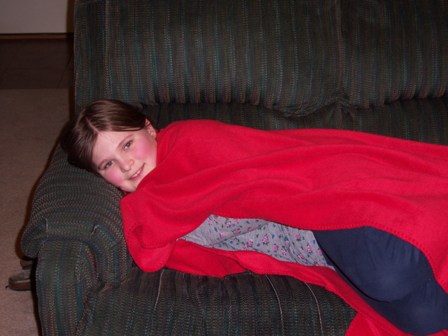
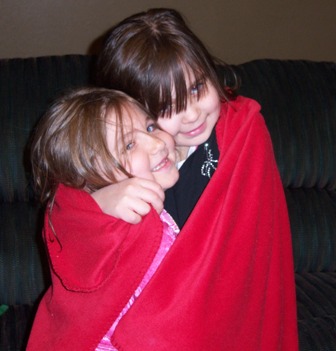
Before Christmas, she mailed me the coolest goodies.  Inside, I found signed Larissa Ione books (fan girl squee!), shells, and RT swag, including dozens of postcards, bookmarks, and a big comfy red blanket.

Of course, I didn’t get to keep the blanket for long. 

Princess Monster snuggles


Someone was always stealing my blanket! 

Middle Monster hugs (chokes) Littlest Monster

Then some wonderful news came.  I danced and yelled down the hall and the monsters came running.  When they heard the news, they grabbed the red blanket and raced around the house shouting and waving it like a banner.

You see, Conn and Rae of Letters to an English Professor have found a home at:

Samhain
Samhain Publishing

Conn’s story will be getting a new title too.  So if any of you have read snippets or my blabbering about the story and have a title suggestion, shout it out!

Thanks to everyone who has read Letters in its various incarnations and provided feedback; who gave me the courage to send out such a spicy story; who talked me off the cliff once or dozens of times; and a huge thank you to Angela James and Samhain for giving Dr. Connagher a chance for more pop quizzes and smoldering poetry lessons!

Posted on 3 Comments

NSR Block

Revision Xibalba has been going well the last few weeks.  Which is good.  Great!  Until I ran out of “Block” today.

NSR contains the most complex plot I’ve ever woven before.  Although the first draft is finished–so I know where the main story arc goes and ends–I’ve added two new POVs, each with its own sub-plot.  Those two sub-plots meet at the same time the main story arc reaches its climax.  Revision “Hell” has been appropriate, because I’ve got several concurrent threads to handle, in different parts of the world, but they have to MEET at the right time.  Some sections are finished in first draft.  Others I haven’t started.  Now as I work through the second major draft, some scenes have been edited and smoothed.  Others haven’t.

It’s been insane, challenging, and even though I may bitch about it, I’m loving every minute of it. 

I’ve used section “blocks” (like the one I created for 7 Crows last night) many times before, but this time, I needed more detail than ever.  I ended up using the “Day Sheet” idea talked about in Karen Wiesner’s First Draft in 30 Days (which oddly, I’ve never used for first draft, but for major revisions!) and manipulating it into something useful for this project.

Today over lunch, my great achievement was going through the old first draft, my stack of notecards, my jotted notes, and finishing the Day Sheet, at least a first draft which can be used to complete the rest of the revision.  (Note:  I’m not a rigid writer.  This spreadsheet WILL change.  It gives me a guide to go by, but if in writing the section, I feel a break is needed or a different scene will flow better, I’ll do so, and then make the corresponding change to the table.)

At a glance, this is how much work I have left to finish.  Notes follow the table.


Day Scene POV Total POVs for Character Status Location Chapter Count Scene Title
3 PM 039 Tara 6 FD Dallas        Haunted
3 PM 040 Ruin 8 SD Lake Atitlan     My Last Sacrifice
3 PM 041 Jaid 22 SD Lake Atitlan     Everything has a Cost
3 PM 042 Quinn 6 FD Dallas     Bad Things, Amigo
3 PM 043 Ruin 9 SD Chi’Ch’ul     Price of Sacrifice
3 PM 044 Jaid 23 SD Chi’Ch’ul     Jaguar Kiss
3 PM 045 Jaid 24 SD Chi’Ch’ul     Through the Navel
3 PM 046 Tara 7 IP Venus Star     Nightmares Come Alive
3 PM 047 Ruin 10 FD Chich’en Itza     Low Reserves
3 PM 048 Jaid 25 FD Chich’en Itza     Everyone Dies
3 PM 029 Quinn 7 NS Dallas     Team Update
4 AM 050 Ruin 11 FD Chich’en Itza     Cost of Magic
4 AM 051 Jaid 26 FD Chich’en Itza     Hidden Dagger
4 AM 052 Ruin 12 FD Chich’en Itza     Blood Keyed
4 AM 053 Jaid 27 FD Chich’en Itza     Drowning in Blood
4 AM 054 Tara 8 NS Venus Star     Save a Life
4 PM 055 Jaid  28 FD Iximche     Doomed
4 PM 056 Jaid 29 FD Iximche     Translation Under Duress
4 PM 057 Ruin 13 FD Iximche     Heart’s Duty
4 PM 058 Quinn 8 NS Dallas     Hospital Visit
4 PM 059 Jaid 30 FD Iximche     Iximche Key
4 PM 060 Jaid 31 FD Iximche     Desperate Bargain
4 PM 061 Jaid 32 FD Iximche     To Xibalba
4 PM 062 Tara 9 NS Venus Star     Venus Star Showdown
4 PM 063 Ruin 14 FD Iximche     Butterfly’s Devastation
4 PM 064 Jaid  33 FD Iximche     The Caged Heart
4 PM 065 Ruin 15 FD Iximche     My Heart is Yours
4 PM 066 Quinn 9 NS Venus Star     The Dallas Gate
4 PM 067 Jaid 34 FD Iximche     The Final Death
4 PM 068 Jaid 35 FD Iximche     Broken
4 PM 069 Ruin 16 FD Iximche     Home
4 PM 070 Jaid 36 FD Iximche     Closed and Locked
4 PM 071 T/Q 10 NS Venus Star     Tie Up
4 PM 072 Jaid 37 FD Iximche     Tie Up


Notes:

  • Color coding is important for me.  I can see at a glance if the POVs make a pleasing tapestry of Story.  Usually the color means something specific to a character, or invokes a “feeling” in me about the character. 
  • I ended up not using the chapter and word count columns after I got knee-deep in revision.  I’ll leave them off next time.
  • The day column isn’t specific.  e.g. 3 PM means the 3rd day, sometime after noon and before midnight.  When I finish this draft, I intend to go back through and read for time incongruences only.  e.g. I can’t have Tara do something in the morning, and then switch the scene and it’s night in Guatemala, and then go back to Dallas and it’s noon.  This isn’t science fiction!
  • I pick section titles that should immediately invoke the details of the section, but the day sheet alone isn’t enough of an “outline” for me, if very much time elaspes.  E.g. I have notecards for each section with details and thoughts jotted down, and every time I *don’t* write something down because I think I’ll remember it, I end up kicking myself.
  • Status = FD (first draft complete), SD (second draft with editing/smoothing complete), IP (in progress), NS (not started).
  • I backtracked to the scene in red at the top because it needs a rather major revision after I finished the rest of the block today.  I have something happening too early there and it needs to be removed.

Have you ever done or needed something this complex before?  Or am I simply making it too hard on myself?  :mrgreen: