Posted on 10 Comments

Shadowlight Giveaway

Everybody should already know that I love Lynn Viehl and how much I enjoyed Shadowlight in particular.  The science aspect in this new spin of the Darkyn series was particularly interesting, and I can’t wait to see how Rowan’s book unfolds.

Since today is the “official” release of Shadowlight (although it’s been shipping for at least a few days), I thought I’d do a giveaway!  Simply comment on this post about your favorite Lynn Viehl book.  If you haven’t read her yet–WHY NOT?!?–simply throw your name in the hat.  I’ll accept comments through midnight CST Thursday, Oct. 8th and announce the winner Friday morning.

This giveaway is open to anyone on the planet, even if you’ve won something from me before.  I’ll ship anywhere on the planet, too, although if you’d rather have an electronic version, I’ll supply an e-certificate to the online bookstore of your choice.

Posted on 2 Comments

Sex and Vampires

My friend Jenna Reynolds (aka Anna Black) and my beloved sister Molly Burkhart (aka G.B. Kensington) have coordinating posts about the allure of sexy vampires to celebrate the release of their short stories in The Sweetest Kiss erotica anthology.  Later this month, I’ll be giving away one signed copy for Halloween, so stay tuned for details!

Also, don’t forget about the $1.99 or less sale going on at Drollerie Press.

Posted on 1 Comment

Shadowlight by Lynn Viehl

I’ve been hooked on Lynn Viehl’s books ever since I read an ARC of If Angels Burn years ago, so I’m thrilled to read her new twist on the Darkyn universe.  Shadowlight kicks off a new “Takyn” series, but does have cross-over characters from the Darkyn books I know and love. 

There are a lot of new characters introduced, out of necessity to set up the new world.  Hang in there, don’t be discouraged by the large cast, and trust Lynn’s magic.  The “monster” created in this book is terrifically horrible and all the little hints and pieces definitely come together in one wild ride at the end. 

Since Evermore involved poetry, I wrote a sonnet for PBW back in 2007 — unfortunately, it was lost when I moved my blog.  So I thought I’d write a new one!

In shadowlight’s grim, unflinching hold,
Secret shadows are seared by truth’s clear light.
Crimes and horrors, hidden darkness untold,
Bared to Jessa’s weary soul without invite.
She hides alone, untouched and unloved;
Until GenHance tracks her through her special gift.
To save her from torture, Mattias steals his beloved–
Tho she knows him not, and her distrust comes swift.
In shadowlight, Jessa sees his frozen past:
A blizzard storm and centuries of barren ice.
He tells her so many horror tales she’s left aghast–
While their physical connection attempts to entice.
If GenHance gains her shadowlight sight,
Their engineered soldiers will the world ablight.

Posted on 5 Comments

Free Read Take Me: Part Two

Continuing after Conn’s letter:  (first draft only, subject to revision)

“If we already have a real ghost,” Rae grumbled as she stapled another swag of fake spider web beneath the porch eave, “then why does Miss Belle want so many fake decorations?  Maybe she’s only worked up because this is the Bed and Breakfast’s first Halloween.”

“Afraid not, darlin’,” Conn replied from the front yard now turned cemetery.  “Miss Belle has always loved Halloween.  In fact, I think if forced to pick between Halloween and Christmas, she’d choose dressing up like a witch any day.  Speaking of which: don’t be freaked out when she refers to her ‘Book of the Dead.’”  He raised his voice so that his grandmother would hear through the open window.  “That’s merely her cookbook.”

Sure enough, Miss Belle stomped over to the front door and glared at them both.  Rae never thought she’d wish the old lady would wear more pink, her trademark color, but even retina-searing Pepto Bismol would be an improvement over Miss Belle’s costume.  She wore an orange-and-purple-striped broomstick skirt down to her ankles, a goblin-green satin poet’s shirt, and bright red sparkling shoes straight out of The Wizard of Oz.  At least her Spandex tights matched her horrendous green shirt.  Even her old-fashioned straw hat had been replaced by a traditional black witch’s hat–with a huge orange bow in the front.

“Don’t spoil Rae’s first Halloween with us,” Miss Belle demanded.  “If you give away all my secrets, she won’t enjoy the party nearly as much.  Now you two hurry up–you don’t even have your costumes on yet!”

Rae concentrated on hanging a huge hairy tarantula on her fake web.  She knew that Conn was going to wear his warrior garb he typically wore for Renaissance Faire demonstrations.  He’d planned a mock fight with his best friend and math professor extraordinaire for tonight’s festivities.  So far, he didn’t have any idea what her costume was–and she planned to keep it that way as long as possible.

She scrubbed her damp palms on her jeans and jumped down off the ladder.  Her stomach already felt tight and trembly with nerves.  Am I going to have the courage to pull this off?

Conn gave the incredibly realistic tombstone another shove so it leaned as if it’d been a part of the yard for decades.  “I’ll be back in about an hour with Mason–he’s meeting me at the cottage.”  He looked up at Rae and she gave him a hopefully excited—instead of nervous—smile.  “You still won’t tell me what your costume is?”

“Nope,” she replied tartly, imitating his grandmother’s no-nonsense manner.  “You’ll see soon enough.”

He reached through the porch railing and gripped her calves.  “Why the secrets, darlin’?”

He had incredible hands.  His powerful fingers dug into her muscles, firm and strong, just shy of actually hurting.  He might be an English professor by day, but in his bed he was all domination.  The slight squeeze of his fingers made her swallow and sent a warm wave of desire sweeping through her.  The butterflies disappeared and she made the low, ragged sound in her throat that he loved to hear.  “I want to surprise you.”

His eyes blazed like sapphires, but he released her.  “How will I recognize you?”

Miss Belle smacked him on the top of the head with her witch hat.  “If you can’t recognize your one true love despite a simple costume, then you don’t deserve her.  Now get–I’ve got to get my cauldron started!”

Posted on 5 Comments

Civil War Anthology: Defiance

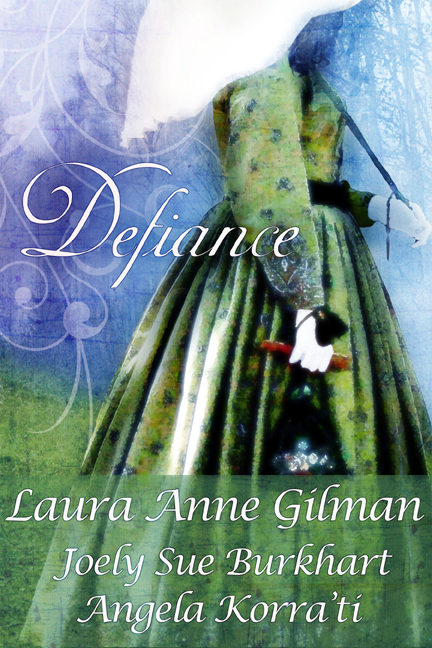
Remember that little Civil War short story I was working on a few months ago?  I’m thrilled to announce that it’ll be included in a US Civil War anthology from Drollerie Press, including stories by Laura Anne Gilman and Angela Korra’ti!  Watch for it to be released end of October.  Isn’t the cover lovely?

Defiance

Posted on 7 Comments

Drollerie Press Blog Tour

This month, our theme is music, and I’m honored to host Nora Fleischer.  Mark your calendars for the next Drollerie Press chat on September 27th at 4 PM Eastern.  We always have a ton of fun and usually end up talking about zombies, Muppets, Sting, and everything in between!

(My post will be posted sometime today at Sarah Avery’s livejournal here.)

~ * ~

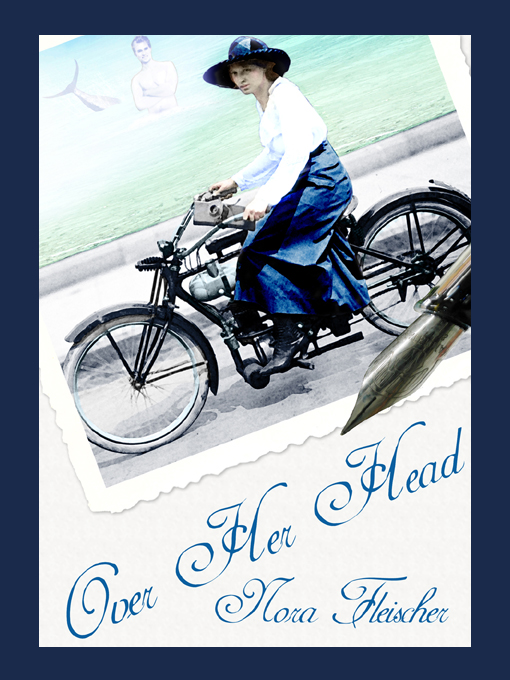
Over Her HeadI love setting stories in the early twentieth century, partly because I like the popular novelists of the era (dig up The Wall Street Girl, if you can, for a fun read), but mostly because they’re the first generation to be recognizably modern.  They have cars, bicycles, and telephones.  For the first time, young women get educated and work in jobs that use their education.  (They called them New Women.)  And, for the first time, people are able to record music. 

Recording music must have been a great thing for musicians– can you imagine knowing that your art would disappear as soon as it was completed?– but it might have been even better for the average music lover.  Imagine living in a period when hearing good, professional-quality music was a rare treat, not something you could get for free just for snapping on the radio!  When if you wanted to hear music, you’d better learn to play an instrument.

Garrett Hathaway, the hero of my novella, Over Her Head, set in 1905, is a huge opera fan, and he treasures his Victrola.  What sort of thing might an opera lover in the early 1900s be able to listen to?  Here’s a recording from the Library of Congress’s American Memory site:  http://memory.loc.gov/mbrs/berl/131113.mp3.  The sound quality makes me very happy to have an iPod!  But here’s the challenge for me as a novelist– people like Garrett were very proud and excited about all the opportunities that modernity brought to them.  I hope, by showing the way Garrett enjoys listening to music, I’m able to convey that excitement to today’s reader.”

Posted on 2 Comments

Story Building 7: The Block

Are you sick of plotting yet?  I certainly am.  I’ve almost come to the place where I’m going to start writing, even if I don’t have all the details figured out.  I feel stuck, mired in the mud, and I need progress.  Again, we come back to “do what works for you.”  If the process becomes painful, boring, or tedious, why are you still doing it?  However, I know from past experience that if I rush too much, I’ll have more revisions to make in order to tighten the story up.  The more thinking and planning I do now, the better the first draft will be.  I don’t want to spend a year revising this story — in fact, I’d really be happy if I could submit it by the end of the year.  (That’s my unofficial goal.)

Loosely, this stage ties to the spreadsheets I showed in the last post — but they’re not quite exactly the way I was taught by the Witch.  Originally, I learned to take a story and break it into 10 chunks, called blocks since they’re the building blocks of the story.  Act 1 contains 3 blocks, Act 2 contains 5, and Act 3 contains 2.  The hero’s journey lies very nicely on top of the blocks:

  • Block 1 = Ordinary World
  • Block 3 = Accepting the Call – ending with Crossing the First Threshold into Act 2.
  • Block 4 (first block of Act II) – Confrontation, Tests, Allies
  • Block 6 = Approach Innermost Cave
  • Block 7 = Dark Moment
  • Block 8-9 = Climax, turning point into Act 3.
  • Block 9 = Climax 2
  • Block 10 = Resolution

This helps you define the structure and pacing of the story and for the most part, this really resonates with me.  Where I ran into problems (creating those spreadsheets) was with the Maya thriller, where I had three major story lines all converging in the last half/third of the book.  I needed a bit more space to keep track of what was happening — so I technically added more “blocks” to the Acts.  It was more of a spacing/usability decision than a structure decision — I couldn’t fit all the details I needed into 2 tiny columns (blocks) for Act 3!

The point I’m trying to make is that structure is well and good — but it should be fluid and flexible too.  If the story you’re writing feels like it needs 3 blocks for Act 3 instead of 2, who cares.  The important part is that you recognize Act 3 should be roughly the last 1/4 of the story and should move very, very quickly.  Act 2 should be the meatiest and encompasses roughly 50% of your story.  Exactly how many blocks that means is up to you.  So feel free to modify this process for yourself, and for each book.

With Victor’s story, I don’t need nearly as much space to write out the rough details of the Block.  I only have 2 POVs.  I have the main story line of Victor and Shiloh’s romance, wound into the premise of the story, that it takes place on a reality show.  I have a subplot about an industry spy.  And that’s it!  The real meat of the story is the relationship and the conflicts that arise because of the show — which feeds directly into the romance, because Shiloh crafted this show down to the littlest detail, for him.

One fun thing that can help you think about structure and story at the same time is to NAME the blocks something meaningful to you and the story.  I had the idea this morning that I should base the blocks on the idea of episode titles for the show.  Not all of them are show titles, but this will definitely give you an idea of what kind of story this is going to be.

Block One – The Pitch

Block Two – Try Outs

Block Three – Premiere

Block Four – Serving Your Master

Block Five – Loving Your Master

Block Six – Do You Know Your Master’s Hand?

Block Seven – At Your Master’s Pleasure…or Displeasure

Block Eight – Miss Belle’s Thanksgiving

Block Nine – Coming Out Ball

Block Ten – V’s Gift

Posted on 1 Comment

Storybuilding 6: The Hero’s Journey

After all our brainstorming and character building fun, now it’s time to begin adding structure to your story.  This is where you weld into place  the foundation and girders that will hold up your storyscraper.

When I first began writing, I didn’t think about structure at all.  I had a story to tell, and I told it.  As I learned more about Story and the writing craft, I realized there were some things I’d done involuntarily.  These things are inherently part of storytelling — keeping the reader involved in a story, speeding up the pacing or slowing it down, throwing more rocks at your character stuck up in that tree.  But for awhile, I remember being terribly confused.  I suddenly knew why I’d done certain things, but then the how began to waiver.  If I’d done something naturally, how could I force it to happen now?

Trust the magic. It’s there.  You’ve been mixing a potion from the very start of storybuilding.  Adding a framework for the story to hang onto will not damage the magic.  On the contrary, it will give it a place to shine.

Knowing the structure of the story helps you guess the length too.  Say you have a really big “candybar scene” already in mind, but you have no idea how far into the story that scene will play out.  Is it in the first third?  The last third?  Somewhere in the middle?  Thinking about structure — and specifically the hero’s journey — will help you figure out in which “Act” the scene lies.

The level of detail you define at this point of Storybuilding is entirely up to you and the story you’re writing.  Don’t be surprised if one story wants more work than others — my process changes a little with each story I write.  I’ve known people who plotted out to great detail with pages and pages of outline and scene details.  I’ve also known people who only have a vague idea of the ending and that’s what they’re writing toward.

The whole point of this exercise is to get a story to the place where you can successfully begin writing.  By “successfully” I mean that you’re setting yourself up to FINISH THE BOOK.  In the end, that’s the only victory.  Do whatever you need to do to finish the book.  Plot a lot — plot only a little.  Write up detailed character sketches — or just a few emotional letters.  Whatever you need to.  Finish. The. Book.  You can plaster over holes, demo entire rooms or floors of the storyscraper if you need to, LATER.  You can’t see enough of the Story structure and how it fits into the skyline you envisioned until you finish the first draft. Renovation Nightmares will begin later.  :mrgreen:

If you at least know the ending of the book, then you have  a target to shoot for.  If you know the major inciting incident that sets the story in motion, then you know how to write the first 100-120 pages of the book.  If you can get a few additional key scenes or surprises laid out in your mind, then you’ve got something to write to in the middle.  How much more detail you add at this point is entirely up to you.

Personally, how much work I do depends on the length of the story.  Ironically, very short and very long pieces take about the same amount of work.  In a short story, you need to choose the scenes very, very carefully.  A good short story is still going to have a character changing in some memorable way, and the few precious words must reflect those changes quickly.  A long (e.g. 100K or more) story has a lot of Deadly Middle Ground to conquer.  If I don’t have a few key turning points already identified, I’m going to get stuck halfway over the mountain, and that’s not a good place to be.

There are a ton of great Hero’s Journey links available on the internet.  Also check out our character clinic and Left Behind & Loving It categories; my friend Jenna wrote up a great post about how she uses the hero’s journey.  I refer back to Vogler’s The Writer’s Journey constantly.

Minimally, I like to know the following journey points of a story before I begin writing (and why).  I do a lot of this brainstorming on paper, and then when I know the rough idea of the “scene,” I write out a card for it.  One card may spawn another idea, so I jot that down.  Think about reactions – you can get another card or so for each main POV character after a turning point scene.  How did Victor feel when THIS happened?  What’s he going to do now?

  • Ordinary World:  this helps me figure out how to start the book in the right place.  Note that you still have to have ACTION happening here.  Characters in the shower, waking up from a dream, etc. are boring
  • Inciting Incident:  this is the Big Bang that sets your story universe into motion.  It’s the event that sets your hero’s feet onto the yellow brick road of your journey.
  • Crossing the Threshold:  this scene helps me know that Act I is finished and I’m moving into the middle.  The first Act should be roughly 100-120 pages (in a 400 page book).  If my character takes the first step on the main journey — and I only have 50 pages — then this is going to be a very short novel.  Maybe that’s okay – or maybe I need more details.
  • Midpoint Shakeup:  Okay, I lied, this isn’t part of the hero’s journey, not exactly.  But I love to have a big major event in the midpoint of the story.  It’s the candybar I’m writing toward that helps me get the next 100-150 pages.
  • Approaching the Innermost Cave, the Dark Moment:  there comes a time when the hero believes all is lost, the journey is hopeless, the battle will never be won.  This is signaling the end of Act II.  Even though I’m on the downhill slide at this point, I always get bogged down around 275-320 pages of a book.  It’s like the bleak emotions begin to take their toll on me — and I find myself in my own dark moment.  This is where I begin to wonder if I’m going to be able to pull the story off.  This would be a really really bad time for me to read a negative review or allow any harsh words to inflict any damage on my writer’s psyche.  This is a whole other post — but protect the writing.  Protect yourself.  “Having a thick skin” does not mean that you need to shovel other people’s caca with a smile!
  • The Climax(es):  Ah, the showdown begins.  The last 100 pages–once they get rolling–should just fly.  Now your hero goes to battle.  You throw every surprise and horror at him/her that you can think of.  If you’re really doing good, you’ll write them so far into a dark dead-end alley that even YOU won’t have any idea how to get them out.  Yes, this still happens, even if you “plot” the story.  Let the magic happen.
  • Resolution and Return:  in the last 20 pages or so, tie up all loose ends, decide how your character is going to live out the rest of his life, grieve for the fallen, and soak in the victory.  I don’t always do a ton of plotting for this stage — unless there’s a book that follows.  Then I need to make sure that the elements I need to bridge into the next book are present and make sense.

Now you may feel as exhausted as your characters, but I promise, nothing, absolutely NOTHING, compares to the rush you’ll feel when you type:

The End.

P.S. If spreadsheets don’t scare the crap out of you, you may find these helpful.  These are filled out for the Maya thriller.  The character rows are the major players that I needed to track through the story, even if they didn’t have a POV.  Note that I didn’t do this much plotting before the first draft — this level of detail came during Revision Xibalba.

The Bloodgate Codex spreadsheets

If you’re interested in the blank templates, I’ll post them later — I don’t have them handy on this computer.